To build local citations correctly, create one accurate master version of your business information, audit existing listings, correct genuine inconsistencies and duplicates, then submit your business to authoritative general, industry-specific, and location-specific platforms.
The goal is not to create the largest possible number of listings.
It is to build a reliable network of business references that accurately describes the same real-world company across the places customers, search engines, maps, directories, and AI-powered discovery systems may use to understand it.
A practical citation-building process looks like this:
- Establish your canonical business information.
- Audit citations that already exist.
- Fix incorrect information and duplicate listings.
- Claim your major business profiles.
- Prioritize directories based on relevance and authority.
- Add industry-specific and geographically relevant citations.
- Complete listings beyond basic NAP information.
- Track verification and live URLs.
- Monitor important listings when business information changes.
- Support citations with strong website and Google Business Profile signals.
Google does not publish a rule saying that a business with a certain number of citations will rank higher. Google says local results are primarily influenced by relevance, distance, and prominence, and prominence can include information Google finds across the web. Citations should therefore be treated as part of a broader local search ecosystem rather than as a standalone ranking trick.
That distinction matters.
If your Google Business Profile is incomplete, your location pages are weak, your reviews are poor, and your website gives Google little evidence about what you actually do, creating another 150 directory profiles probably will not solve the underlying problem.
Citation building works best when it reinforces an already clear business entity.
What Are Local Citations and Why Do They Still Matter in 2026?
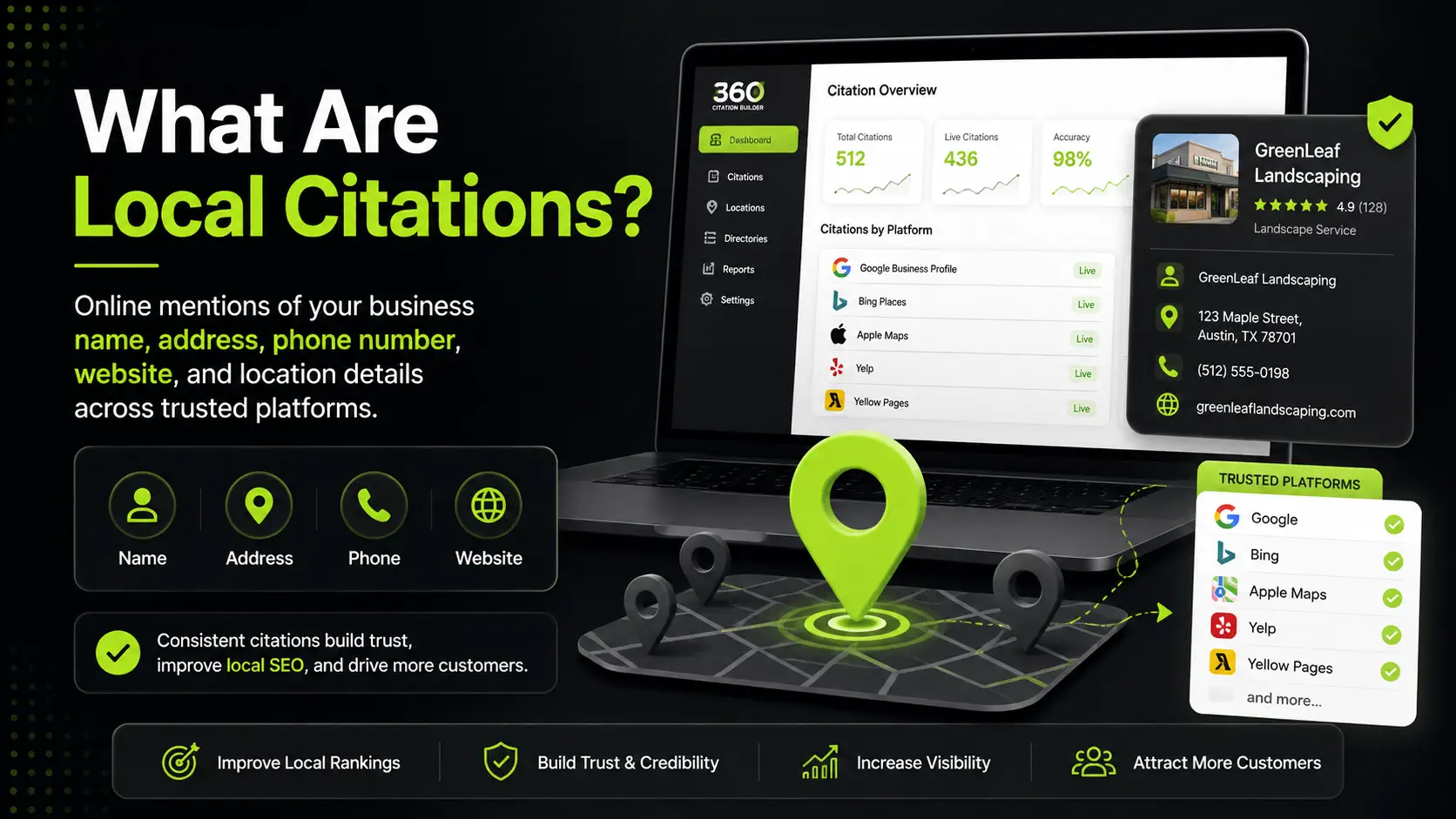
A local citation is an online reference to a business that identifies the company using information such as its business name, address, phone number, website, location, or other identifying details.
The classic citation contains what local SEOs call NAP: Name, Address, and Phone Number.
But treating citations as nothing more than three fields in a directory misses the bigger picture.
Modern local search is increasingly about entity understanding.
Google can encounter information about the same company on its official website, Google Business Profile, Apple Maps, Bing, Yelp, Facebook, professional associations, chambers of commerce, industry directories, government databases, news websites, review platforms, and many other sources. Google also explicitly supports structured data containing details such as business names, addresses, phone numbers, URLs, and other organizational information to help it understand organizations and local businesses.
Think of it like building a digital paper trail.
Imagine a plumbing company called Harbor Plumbing & Drain.
Its website says:
Harbor Plumbing & Drain
215 Market Street
San Diego, CA
(619) 545-0186
Its Google Business Profile shows the same business.
Its state contractor directory references the company.
Yelp identifies the same location.
A local chamber lists the same website.
Several local publications mention Harbor Plumbing & Drain while linking to its site.
Those references collectively make the business easier to identify across the web.
Now imagine the opposite.
One directory says Harbor Plumbing LLC.
Another uses an old phone number.
Three profiles show a previous address.
Someone created a second Google-style listing using “Best Emergency Plumber San Diego” as the business name.
A business directory points to an expired domain.
That is no longer simply a “citation quantity” problem. It is a business data quality problem.
This is why citation building still deserves a place in local SEO—but its role should be understood correctly.
Citations can help with several goals
They can:
- make accurate business information easier to discover;
- place the company on websites potential customers actually use;
- reinforce geographic and industry relevance;
- create referral traffic opportunities;
- help establish a broader online footprint;
- sometimes provide links or mentions to the business website;
- help prevent competitors or third parties from controlling unclaimed profiles.
Google itself encourages businesses to establish accurate information across its ecosystem and notes that its systems can find organization information from publicly available web sources.
So yes, citation building still matters in 2026.
But citation quality, relevance, accuracy, and usefulness matter far more than chasing an arbitrary directory count.
Before Building Citations, Create a Master Business Data Sheet
One of the most expensive citation mistakes happens before the first directory submission.
Someone opens a list of directories and starts submitting.
On directory number one, they enter the legal business name.
On directory number four, they shorten it.
On directory number seven, they use a tracking phone number.
On directory number twelve, they copy an old address from Facebook.
Three months later, nobody remembers which information went where.
That is why the first real step in professional citation building should be creating a master business data sheet.
This becomes the single source of truth for every listing you create or update.
At minimum, document:
| Business Field | What to Record |
| Business Name | Real-world public-facing business name |
| Street Address | Correct customer-facing location, when applicable |
| Suite/Unit | Exact suite or unit information |
| City | Official city/locality |
| State/Region | Correct state, province, or region |
| ZIP/Postcode | Current postal code |
| Primary Phone | Main local customer contact number |
| Website | Canonical website URL |
| Location URL | Specific location page for multi-location businesses |
| Primary Category | Closest accurate business category |
| Secondary Categories | Additional legitimate services/categories |
| Opening Hours | Normal operating hours |
| Special Hours | Holiday or seasonal hours |
| Business Description | Accurate short company description |
| Service Areas | Actual areas served |
| Logo | Current official logo |
| Photos | Approved business/location imagery |
| Social Profiles | Official brand profiles |
| Year Established | Only if accurate and verifiable |
This process sounds basic until you manage twenty locations.
For a multi-location brand, location-level data should be separated. Do not send every directory to the homepage while mixing phone numbers and addresses from different branches.
Each physical location should have its own clearly defined information.
Service-area businesses require even more care. Google specifically states that businesses that do not serve customers at their physical address should remove that address from the Business Profile and use a service area instead. Google also recommends accurate, specific service areas.
That does not mean you should invent virtual offices or fake city addresses simply to create citations in additional markets.
Your citation strategy should describe the business that actually exists.
A useful rule
Before submitting anywhere, ask:
“If a customer found this information independently, would it accurately describe how they can identify, locate, or contact this business?”
If the answer is no, fix the master record before continuing.
This document will save hours later when you begin auditing listings, assigning work to staff members, outsourcing citation building, or updating dozens of profiles after an address or phone-number change.
Step 1: Audit Your Existing Local Citations Before Creating New Ones
Searching for directories and immediately creating new listings feels productive.
It can also create a mess.
Many established businesses already have citations they do not know about.
The business may have been added automatically by a directory, submitted years earlier by an employee, created by a previous SEO provider, imported from another data source, or generated before the company changed its address or phone number.
Creating another listing without checking first can produce duplicates.
That is why citation auditing should come before citation building.
The competitor article we reviewed also places auditing before new submissions, which is a sound sequence.
Start by searching for several variations of the business.
For example:
“Harbor Plumbing & Drain”
Then:
“Harbor Plumbing & Drain” San Diego
Then search the primary phone number, old phone numbers, street address, and previous business names if applicable.
You are looking for four major situations:
1. Correct existing citations
These already contain reliable information.
Do not create another profile.
Record the URL and, when possible, claim ownership.
2. Incorrect citations
Perhaps the phone number or website is outdated.
These should be corrected.
3. Duplicate listings
Two or more listings represent the same location.
Do not assume the solution is simply deleting whichever profile looks weaker. Some platforms have specific duplicate-merging or suppression processes.
4. Missing priority citations
The business does not appear on an important platform relevant to its industry or location.
These become candidates for your citation-building queue.
A simple audit spreadsheet might include:
Directory | Existing URL | Name Correct? | Address Correct? | Phone Correct? | Website Correct? | Duplicate? | Claimed? | Action Required | Status
This turns citation building from guesswork into inventory management.
For agencies, the audit is even more valuable.
Suppose a new dental client already has 70 citations, including strong healthcare and city-specific listings. Selling them another package of 100 generic citations without reviewing the existing footprint would add activity without necessarily adding much value.
You may discover that what the client actually needs is:
- ten important corrections;
- two duplicate removals;
- five missing healthcare directories;
- three local association listings;
- and better consistency between the website, Google Business Profile, and major platforms.
That is a much more intelligent citation strategy.
Step 2: Fix NAP Errors Without Obsessing Over Harmless Formatting Differences
You will often hear this advice:
“Your NAP has to be exactly identical everywhere.”
The principle behind that advice is useful.
The literal interpretation can be misleading.
Your important business information should be accurate and consistently identify the same business, but this does not mean every punctuation mark must be identical across the internet.
For example:
215 West Main Street
and
215 W. Main St.
can describe the same physical address.
Likewise:
Suite 204
and
Ste 204
are usually formatting differences rather than evidence that two different businesses exist.
The more serious problems are substantive discrepancies:
- one listing contains an old street address;
- another uses the wrong phone number;
- a location points to another branch’s webpage;
- the company appears under multiple unofficial business names;
- duplicate profiles represent one location;
- a practitioner is incorrectly represented as a separate business;
- a service-area business publishes an address that should not be publicly displayed;
- One listing sends customers to a disconnected number.
BrightLocal defines NAP consistency around keeping business name, address, and phone information uniform across citations, but the practical priority should always be accurate entity identification, not punctuation perfection.
Google’s own business guidelines reinforce that business information should represent the company accurately. For example, a Business Profile should use the real-world business name, and the phone number or website should represent the individual business location.
So when you audit inconsistencies, triage them.
High-priority corrections
Fix these first:
Wrong business name
Especially keyword-stuffed or obsolete versions.
Wrong address
Critical after relocation.
Wrong phone number
A ranking discussion becomes irrelevant if the customer cannot call you.
Wrong website
Particularly URLs belonging to previous owners, old domains, or another location.
Duplicate listings
These can create customer confusion and management problems.
Incorrect business status
For example, a listing marked permanently closed when the company is operating.
Lower-priority differences
Do not spend an entire afternoon trying to change every “Street” into “St.” while major listings still contain the wrong telephone number.
The purpose of citation cleanup is not visual perfection.
It is to make the web’s references to your company truthful, coherent, and useful.
That distinction saves time and produces a citation profile built around real business accuracy rather than outdated SEO superstition.
Step 3: Choose Citation Sources by Relevance and Value not Just Domain Metrics
After your data is clean, you can finally start identifying new citation opportunities.
This is where many citation campaigns go wrong.
Someone finds a list titled “500 Free Citation Sites”, submits the business everywhere possible, and assumes the job is finished.
A smarter citation strategy works in layers.
Core platforms
Start with major platforms that customers, search engines, mapping services, or digital assistants are reasonably likely to encounter.
Depending on the country and business, that may include platforms such as:
- Google Business Profile
- Apple Business Connect
- Bing Places
- Yelp
- major mapping or navigation ecosystems
Google recommends claiming and maintaining your Business Profile so you can control information such as contact details, business type, location information, and photos in Google Search and Maps.
Industry-specific citations
Next, identify platforms that matter within the business category.
A lawyer and a restaurant should not have identical citation strategies.
For example:
| Industry | Example Citation Opportunities |
| Legal | Legal directories, bar associations, lawyer profiles |
| Healthcare | Practitioner directories, healthcare platforms, professional bodies |
| Home Services | Contractor platforms, trade associations, local home-service directories |
| Hospitality | Travel, restaurant, reservation, and tourism platforms |
| Automotive | Automotive service and repair directories |
| Real Estate | Property, agent, brokerage, and professional association platforms |
The question is not simply:
“Does this directory have high authority?”
Ask instead:
“Would Google or a potential customer reasonably expect a legitimate business in this industry to appear here?”
Geographic citations
These establish a stronger real-world connection with the location.
Look for:
- local chambers of commerce;
- city business directories;
- regional trade associations;
- neighborhood organizations;
- tourism directories;
- local newspapers and publications;
- business improvement districts;
- sponsorship pages;
- community organizations.
A local chamber listing may be dramatically more meaningful for a business in Phoenix than directory number 193 on a generic international list.
Competitor citation gaps
Search businesses that consistently perform well for the local queries you care about.
Then investigate where those legitimate competitors are mentioned or listed.
You are not blindly copying their backlinks.
You are looking for patterns.
If several respected competitors appear in a state association directory you missed, that is useful evidence.
If all of them are mentioned by an important regional publication, that may reveal a local visibility opportunity.
Use this citation qualification test
Before adding a directory to your build list, score it on four questions:
Relevance: Is the website connected to my industry, location, or customers?
Legitimacy: Does the platform appear to be a real, maintained website rather than a mass-generated directory?
Visibility: Can customers or search engines realistically discover the listing?
Accuracy/control: Can I create, claim, verify, or update the business information?
A platform does not need to score perfectly in every category.
But if the only reason you are submitting is “the website has a high DA,” you probably need a better reason.
Google itself describes local ranking through relevance, distance, and prominence—not a directory-count metric.
The best citation campaign therefore does not ask:
“How can I get 300 citations?”
It asks:
“Which references would make the online footprint of this particular business more complete, credible, locally relevant, and useful?”
That change in mindset is what separates citation building from directory spam.
Step 4: Claim and Verify Important Business Listings
Finding a business listing is not the same as controlling it.
Whenever an important citation platform allows business owners to claim or verify a listing, that should usually be preferred over leaving an unmanaged profile sitting online.
Why?
Because ownership gives you a better chance of keeping important information accurate when something changes.
Imagine that a roofing company changes its phone system. Its website and Google Business Profile are updated immediately, but dozens of old directory listings still contain the previous number.
Customers searching those directories may call a disconnected line.
A citation technically exists—but it is now doing more harm than good.
Claiming important listings helps prevent that situation.
Start with the platforms that have the greatest visibility or relevance to your business rather than trying to claim every obscure directory you discover.
For Google specifically, a business can add or claim a Business Profile and must complete an available verification method before gaining full control. Google determines which verification options are available for a particular business, and methods may include options such as video, phone, email, live video, or mail depending on eligibility.
Google also notes that video verification can be used for storefront, service-area, and hybrid businesses, with the required evidence depending on the business type.
The broader lesson applies beyond Google:
Do not build citations and disappear. Build assets that the business can control.
Keep ownership centralized
One mistake I frequently see in citation projects is profile ownership being scattered across random accounts:
- an old employee’s personal Gmail;
- a freelancer’s email address;
- an SEO agency account nobody can access anymore;
- several different company inboxes;
- forgotten social accounts.
That creates a serious operational problem when the company needs to update information later.
Instead, create a simple ownership system.
For every important citation, document:
| Field | Example |
| Platform | Major directory |
| Listing URL | Live profile URL |
| Account Email | listings@company.com |
| Claimed | Yes |
| Verified | Yes |
| Verification Date | August 2026 |
| Owner | Marketing Team |
| Notes | Main location |
Passwords should be handled through an appropriate company password-management system rather than stored in an unsecured spreadsheet.
Claim existing listings before creating replacements
If you discover an existing profile representing your business, do not automatically create a new one.
First determine whether the existing profile can be claimed.
For example, Apple allows businesses to manage locations through its current business-management system and provides a process for requesting control of locations that are already managed by another organization.
Similarly, Google provides ownership and verification processes instead of encouraging legitimate businesses to create duplicate profiles.
This gives us a useful citation-building principle:
Search → identify → claim → correct → verify → then create only when necessary.
Not:
Search → cannot immediately access → create duplicates.
That small difference prevents a large percentage of citation cleanup problems.
Step 5: Complete the Entire Citation Profile, Not Just Name, Address, and Phone
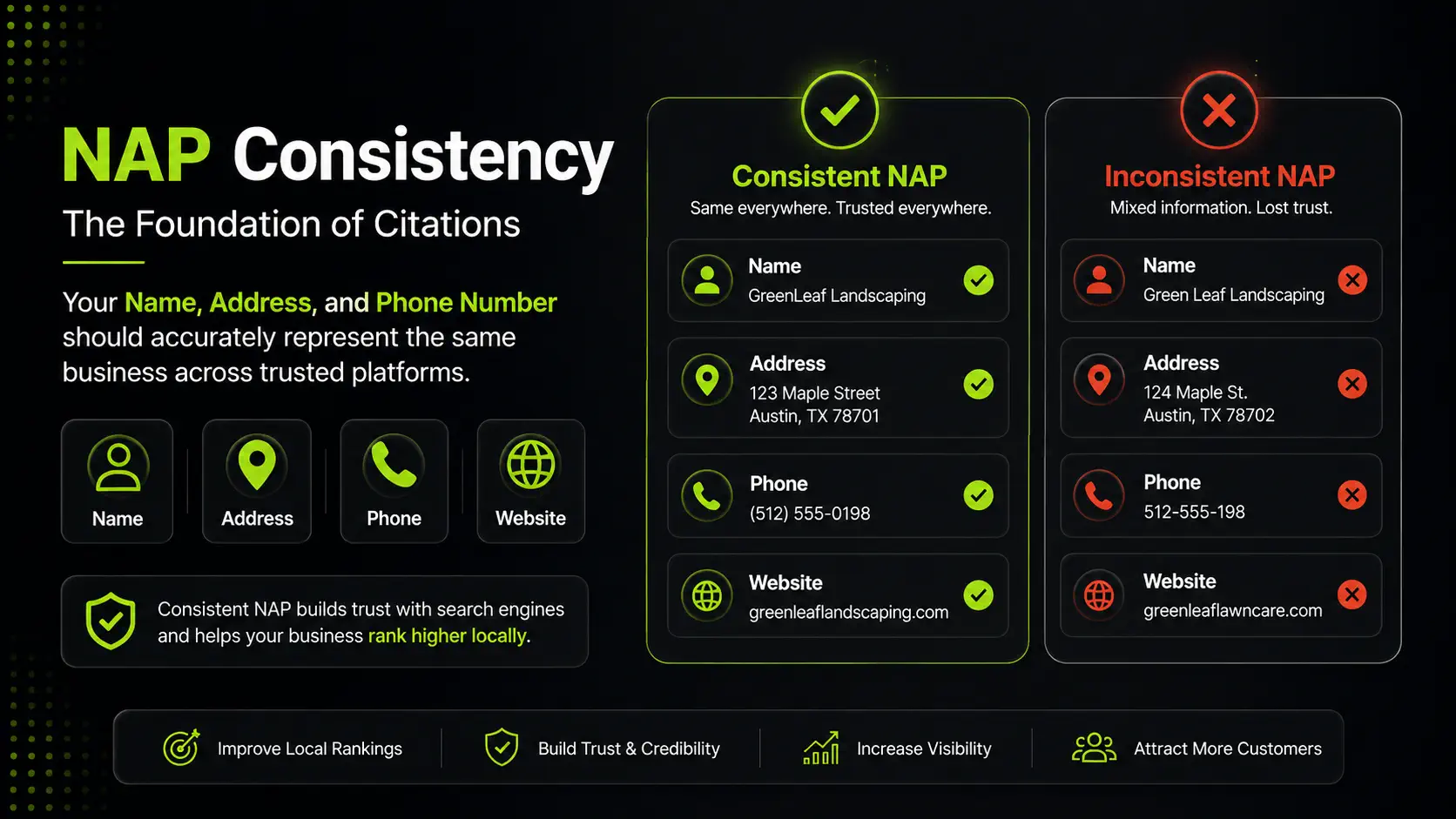
NAP is the foundation of a citation, but stopping at NAP wastes much of the value of a business profile.
A strong listing should answer as many legitimate customer questions as the platform allows.
Google itself recommends maintaining complete and accurate Business Profile information, including details customers use to understand what a company does, where it operates, and when it is available.
Google’s service-business documentation also shows that profiles may include information such as business name, website, phone number, operating hours, reviews, and services.
That is a useful model for citation building generally.
Instead of thinking:
“I need to submit the NAP.”
Think:
“I need to build the best accurate representation of this business that this platform permits.”
Complete relevant fields
Depending on the directory, this may include:
- business name;
- address or service area;
- phone number;
- website URL;
- business categories;
- operating hours;
- services;
- company description;
- photos;
- logo;
- social profiles;
- payment methods;
- accessibility information;
- appointment links;
- menu or product URLs;
- founding year;
- professional credentials;
- service specialties.
Only add information that is genuinely accurate.
Do not select twenty unrelated categories simply because the directory allows it.
Do not claim services the company does not offer.
Do not write “24/7 emergency service” unless the business actually operates that way.
And do not turn the business description into a keyword warehouse.
For example, this is poor profile copy:
Dallas Plumber Best Dallas Plumbing Company Emergency Plumber Dallas Drain Cleaning Dallas Water Heater Dallas TX Plumber.
It reads like metadata from 2009.
A better description would explain the business naturally:
ABC Plumbing serves homeowners and commercial properties across Dallas with drain cleaning, water heater repair, leak detection, pipe repair, and emergency plumbing services.
Relevant keywords appear because they describe the company—not because they were forced into the text.
Use the correct landing page
This becomes especially important for multi-location businesses.
Suppose a company has locations in:
- Houston;
- Austin;
- Dallas;
- San Antonio.
The Dallas listing should generally connect users to the most useful Dallas-specific page rather than making every location point to a generic homepage when dedicated location pages exist.
The same principle applies to phone numbers.
Where appropriate, each location should use the contact information that actually represents that branch.
Google’s business guidelines emphasize that listed phone numbers and websites should represent the individual business location.
Add quality images where appropriate
Profiles with visual elements are also more useful to real customers.
Use genuine:
- storefront images;
- office photos;
- team photos;
- vehicles;
- products;
- completed work;
- interior images;
- branded assets.
Do not upload the same stock photo to every directory and expect it to create trust.
Citation building should improve business discoverability and customer confidence simultaneously.
If the listing ranks but looks abandoned when someone opens it, you have only done half the job.
Step 6: Manual Citation Building vs. Automated Citation Distribution
One of the most common questions in local SEO is:
Should I build citations manually or use citation software?
The answer is not ideological.
Both approaches can make sense.
The correct choice depends on the number of locations, the condition of the existing citation footprint, the markets being targeted, and how much control you need.
Manual citation building
Manual building means identifying citation opportunities and creating, claiming, or updating listings individually.
The main advantage is control.
You can inspect each site before submitting.
You can choose categories carefully.
You can write better descriptions.
You can identify duplicate profiles.
You can skip low-quality directories.
And, most importantly, you can pursue opportunities that automated platforms may never cover.
For example, software might distribute a plumber’s details to several large databases.
It probably will not independently discover:
- the local chamber of commerce;
- a city contractor directory;
- a regional plumbing association;
- a neighborhood business organization;
- a local sponsorship opportunity;
- a state trade directory.
Those manually identified citations can sometimes be the most relevant opportunities in the entire campaign.
Automated or centralized distribution
Automation becomes attractive when scale increases.
Imagine managing 250 retail locations.
Updating operating information one directory at a time is operationally expensive.
Platforms and APIs can simplify portions of that process.
Google itself provides bulk-management options for eligible businesses with larger numbers of locations. Its documentation currently describes bulk verification and management workflows for businesses with 10 or more locations that meet the relevant requirements.
That does not mean every citation campaign should be automated.
It means scale changes the economics.
Which approach is better?
A hybrid model is usually the most practical.
| Situation | Better Starting Approach |
| One local business | Manual + selective tools |
| 2–10 locations | Hybrid |
| Large multi-location brand | Centralized management + manual niche opportunities |
| Major citation cleanup | Manual review first |
| New business | Manual priority setup |
| Agency managing many clients | Tools + QA + manual niche building |
The biggest mistake is confusing distribution speed with citation quality.
Submitting business data to 80 platforms in ten minutes sounds impressive.
But if 35 are irrelevant, eight create duplicates, and the business never controls the accounts, the impressive number becomes less meaningful.
The goal should be:
automation for efficiency, manual work for judgment.
Use tools where repetition adds no strategic value.
Use human review where relevance, duplicates, eligibility, category choice, or local opportunity assessment requires judgment.
Step 7: Build Both Structured and Unstructured Citations
When people hear “local citation,” they usually imagine a directory profile.
That is only one form.
Local citations can broadly be divided into structured and unstructured references.
Understanding both categories helps you move beyond directory-list SEO.
What is a structured citation?
A structured citation presents business information in predefined fields.
For example:
Business Name: Harbor Plumbing
Address: 215 Market Street
Phone: (619) 555-0184
Website: harborplumbing.com
Directory listings, business profiles, association databases, and mapping platforms commonly use this format.
Structured citations are relatively easy to identify and audit because the information appears in predictable fields.
What is an unstructured citation?
An unstructured citation is a contextual reference to the business within normal content.
Imagine a local newspaper publishes:
“Harbor Plumbing donated materials to the San Diego Community Housing Project this weekend.”
That article may mention the business name and city without presenting a formal NAP block.
It is still a meaningful web reference to the company.
Other examples can include:
- local news articles;
- event pages;
- sponsorship pages;
- chamber articles;
- supplier websites;
- professional association content;
- podcasts and show notes;
- community websites;
- university partner pages;
- industry publications.
This matters because a mature local SEO strategy should not consist exclusively of creating profiles on directories.
Once the important structured citations are covered, ask:
Why would legitimate organizations in this city or industry naturally mention this business?
That question creates much better marketing opportunities.
A local HVAC company could sponsor a community event.
A law firm could contribute commentary to a regional business publication.
A restaurant might be featured in a city dining guide.
A contractor could join a legitimate trade organization.
These mentions may produce links, citations, brand visibility, referral traffic, or combinations of all four.
Do not confuse structured data with structured citations
This terminology causes confusion.
Structured citation usually refers to a formatted business listing on another website.
Structured data refers to machine-readable markup added to a website, such as Schema.org markup.
They are related to entity clarity but are not the same thing.
Google explains that structured data helps its systems understand information on webpages, and LocalBusiness structured data can communicate details such as business information and opening hours.
Google also says Organization structured data can help it better understand administrative details about an organization and distinguish it from others.
For a strong local entity strategy, therefore, you can combine:
accurate website information + appropriate structured data + strong business profiles + relevant external citations.
Each piece reinforces clarity from a different direction.
Step 8: Handle Service-Area and Multi-Location Businesses Correctly
Citation building becomes significantly more complicated when a business is not a simple one-location storefront.
Two categories require special attention:
service-area businesses and multi-location businesses.
Service-area businesses
A service-area business travels to customers rather than primarily serving them at a public storefront.
Common examples include:
- plumbers;
- electricians;
- cleaning companies;
- mobile locksmiths;
- HVAC contractors;
- landscaping companies.
A dangerous local SEO tactic is creating fake addresses in every city the company wants to rank for.
For example:
A plumber operates from one legitimate base in Atlanta but wants rankings in Marietta, Smyrna, Austell, and Roswell.
Someone creates four virtual addresses and four business profiles.
That is not a citation strategy.
That is an eligibility and accuracy problem.
Google’s current guidance says that a service-area business that does not serve customers at its business address should remove the address and specify its service area. Google also states that service-area businesses can have only one profile for the area they serve, while allowing businesses to specify up to 20 service areas such as cities or postal codes.
Therefore, you do not need a fake office in every target city to build local visibility.
Instead, strengthen legitimate signals around the real business:
- accurate company information;
- relevant service pages;
- useful location/service-area content;
- authentic reviews;
- local links and mentions;
- industry citations;
- real community participation.
Multi-location businesses
A true multi-location company is different.
Imagine a dental group with actual staffed practices in Atlanta, Marietta, and Decatur.
Those locations may legitimately need separate profiles and citation records because they represent distinct physical locations.
Create a separate master data record for every branch:
| Location | Phone | Landing Page | Address |
| Atlanta | Unique/valid | /atlanta/ | Atlanta address |
| Marietta | Unique/valid | /marietta/ | Marietta address |
| Decatur | Unique/valid | /decatur/ | Decatur address |
Do not mix them.
A common problem occurs when the Marietta citation contains the Atlanta phone number but links to the Decatur page.
Technically every piece of information belongs to the same brand.
Together, however, they describe no actual location.
Google provides bulk Business Profile management options for larger eligible multi-location organizations, reinforcing the principle that legitimate separate locations should be managed as distinct location records rather than collapsed into one confusing data set.
The simple decision rule
Ask:
Does this location exist as a genuine customer-facing or otherwise eligible business location, or are we creating it only because we want to rank in that city?
That question eliminates many bad local SEO decisions.
Citation building should document reality.
It should not manufacture locations that do not exist.
Step 9: Find Citation Opportunities Your Competitors Already Have
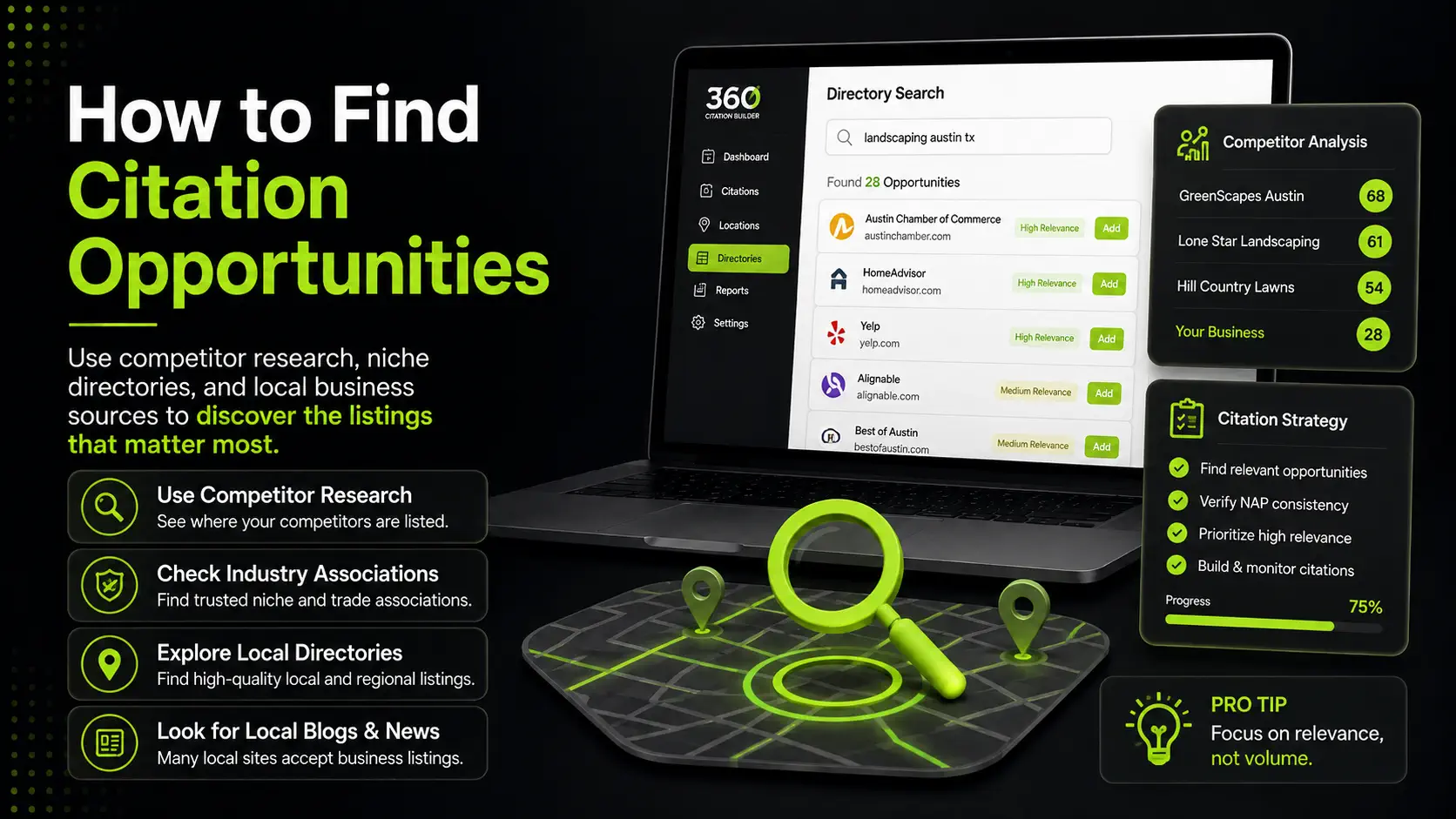
One of the fastest ways to improve a citation strategy is to stop guessing.
Instead of starting with a generic directory list, study businesses that already perform well in the local search results you care about.
This does not mean copying competitors blindly.
It means using them as market evidence.
Suppose you operate a personal injury law firm in Tampa.
Search the terms that matter:
- personal injury lawyer Tampa;
- car accident attorney Tampa;
- injury law firm near me;
- truck accident lawyer Tampa.
Now identify the firms that repeatedly appear across local results and organic search.
Then investigate where those businesses are referenced online.
You may uncover:
- legal directories;
- local chamber memberships;
- city business associations;
- sponsorship pages;
- professional organizations;
- regional publications;
- local news mentions;
- industry-specific platforms;
- community event pages.
If several strong competitors appear on the same legitimate website, that is often more interesting than finding another generic directory from a “top 500 citations” list.
Why?
Because repeated competitor presence can reveal market-specific citation ecosystems.
A roofing contractor in Phoenix may discover that competitors are listed in Arizona contractor resources.
A dentist in Chicago may find healthcare directories and neighborhood business organizations.
A wedding venue may uncover local tourism sites, vendor directories, and event-planning publications.
These are not random citations.
They are contextually relevant.
Build a competitor citation gap sheet
A simple spreadsheet can look like this:
| Citation Source | Competitor A | Competitor B | Competitor C | Your Business | Priority |
| Local Chamber | Yes | Yes | Yes | No | High |
| Industry Directory | Yes | Yes | No | No | High |
| City Business Guide | Yes | No | Yes | No | Medium |
| Generic Directory | Yes | No | No | No | Low |
This helps separate patterns from one-off noise.
A source appearing across several legitimate competitors deserves investigation.
But do not assume every competitor citation is worth replicating.
Competitors can have poor SEO too.
You may find:
- outdated directory listings;
- spam directories;
- duplicate profiles;
- scraped websites;
- irrelevant international directories.
Your job is to identify useful gaps, not reproduce every URL in a competitor backlink report.
Look beyond direct competitors
Another useful tactic is analyzing adjacent businesses.
A wedding photographer may inspect:
- wedding venues;
- florists;
- bridal shops;
- event planners.
Why?
Because those businesses participate in the same local industry ecosystem.
They may reveal directories, vendor networks, associations, local blogs, and event websites that would never appear in a direct competitor analysis.
This is especially useful for niche businesses where search competitors have limited citation footprints.
Practical takeaway: competitor research should produce a curated opportunity list, not a copy-and-paste checklist.
The best citation gap is not simply a website where a competitor is listed and you are not.
It is a relevant, trustworthy source where your business genuinely belongs.
Step 10: Prioritize Niche and Local Citations Over Low-Value Volume
After covering the major platforms, your next citation opportunities should usually become more specific.
This is where niche citations and geo-relevant citations become valuable.
A niche citation is tied to the business category.
A geo citation is tied to the business location.
The strongest opportunities can be both.
For example, imagine an HVAC company in Denver.
A general directory tells search engines and users:
“This is a business.”
An HVAC association tells them:
“This is connected to the heating and cooling industry.”
A Denver business organization tells them:
“This company operates in Denver.”
A Colorado HVAC contractor directory potentially reinforces both industry and geography.
That is why context matters.
Examples of niche citation opportunities
Depending on the industry, this may include:
- professional associations;
- licensing databases;
- trade organizations;
- supplier or manufacturer dealer directories;
- industry review platforms;
- specialist marketplaces;
- professional membership directories;
- certification bodies.
For example, a home-improvement contractor may qualify for supplier dealer directories that a restaurant would never belong on.
A therapist may qualify for professional healthcare platforms that would be irrelevant for a plumbing company.
This relevance makes the citation feel natural.
Examples of geo-relevant opportunities
Look for:
- chambers of commerce;
- city business directories;
- downtown business associations;
- neighborhood organizations;
- regional economic-development sites;
- local tourism sites;
- community sponsorship pages;
- local event directories;
- city media outlets.
These sources are often overlooked because they do not always appear in large SEO tool databases.
That does not make them unimportant.
A legitimate neighborhood association may have far more local context for a restaurant than a high-metric directory covering businesses in 80 countries.
Create a citation priority score
You can use a simple internal scoring system.
Score each potential source from 1 to 5 for:
Industry relevance
Does the site clearly relate to what the business does?
Geographic relevance
Does it connect strongly to the business’s city, region, or service market?
Trust
Does the website appear legitimate, maintained, and useful?
Customer visibility
Could a potential customer realistically encounter the listing?
Control
Can the listing be claimed, updated, or managed?
A source scoring highly across several dimensions should move up the priority list.
This framework avoids a common SEO trap:
chasing third-party authority metrics as if they were the citation itself.
Domain metrics can be useful for analysis.
They should not replace judgment.
A citation should make sense even if you never looked at the site’s SEO score.
Ask yourself:
Would I still want this business listed here if SEO tools did not exist?
If the answer is yes because customers, industry professionals, or local residents actually use the resource, it is probably worth serious consideration.
Step 11: Avoid the Most Common Citation-Building Mistakes
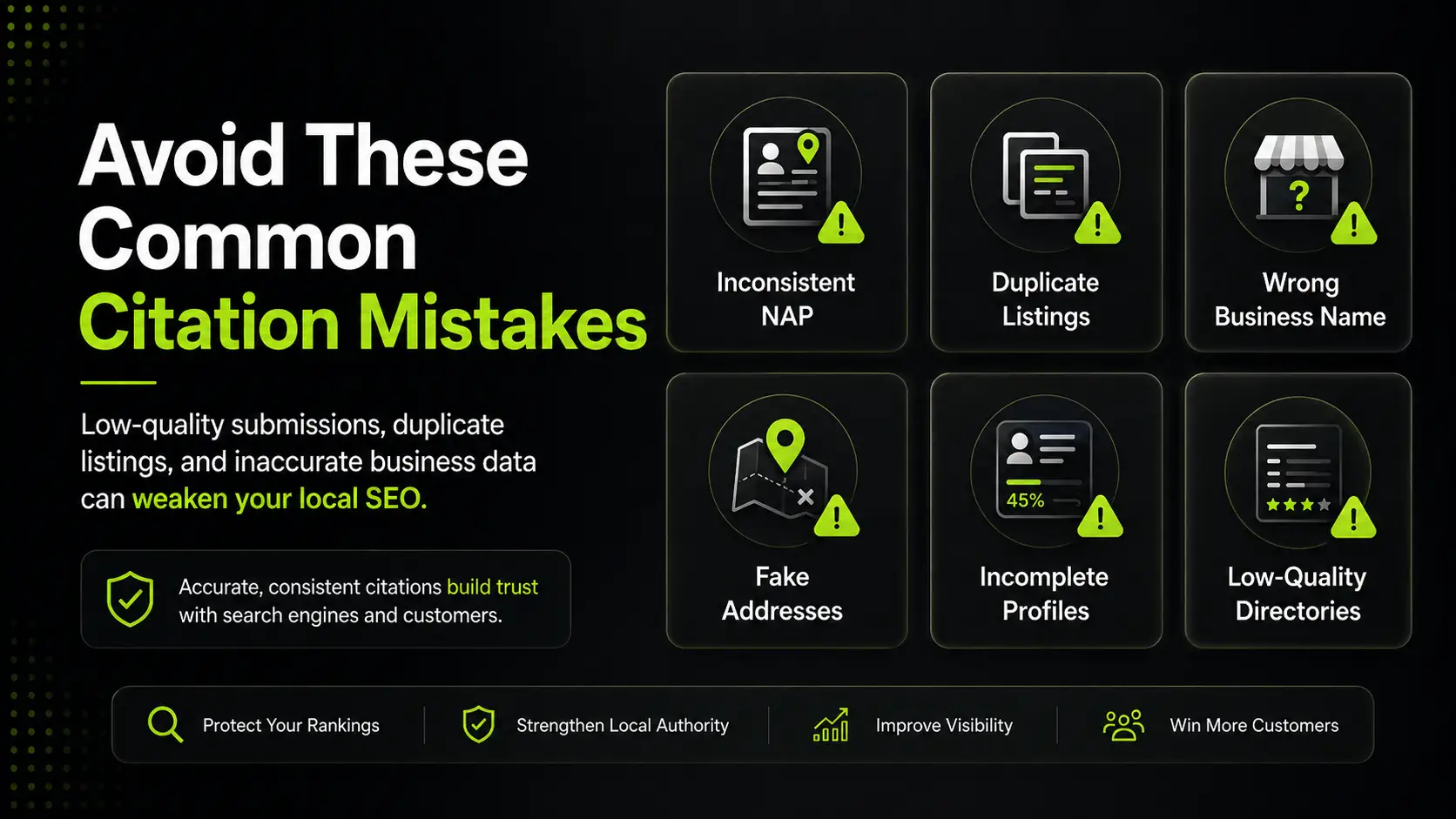
Citation building is simple enough to explain in a few sentences.
Executing it consistently is where problems appear.
Most citation campaigns do not fail because someone forgot what NAP stands for.
They fail because small operational mistakes accumulate across dozens of listings.
Here are the mistakes that cause the most trouble.
Mistake 1: Building before auditing
You submit to a directory that already contains the business.
Now two listings exist.
Always search first.
Mistake 2: Using inconsistent business identities
One person submits:
Smith Plumbing LLC
Another uses:
Smith Plumbing & Emergency Drain Experts
A third uses:
Best Plumber Dallas – Smith Plumbing
These are not simply formatting differences.
They are different representations of the business identity.
Use the real-world business name consistently.
Mistake 3: Using the wrong location data
This is particularly common with franchises and multi-location businesses.
One branch accidentally receives:
- another branch’s phone;
- another city’s landing page;
- old hours;
- corporate headquarters information.
Maintain separate location records.
Mistake 4: Creating citations in bulk without checking relevance
A directory being available does not mean the business belongs there.
If an SEO vendor submits a dentist to construction, automotive, and hospitality directories simply to inflate the citation count, that is not a quality strategy.
Mistake 5: Ignoring duplicates
Duplicates are not always obvious.
Try searching:
- business name;
- phone number;
- address;
- old business name;
- old phone number.
Mistake 6: Leaving profiles incomplete
A listing with only name, address, and phone can be technically correct but commercially weak.
Add accurate:
- categories;
- descriptions;
- hours;
- services;
- photos;
- website links.
Mistake 7: Using fake locations
This often happens when businesses want rankings in nearby cities.
A business rents mailbox-style addresses and creates listings purely for SEO.
This can create both platform-policy and customer-trust problems.
Mistake 8: Forgetting ownership credentials
Six months later, nobody knows which email controls the listings.
Centralize ownership and maintain records.
Mistake 9: Treating citations as a one-time campaign
Businesses change.
They:
- relocate;
- change phone systems;
- update hours;
- rebrand;
- open branches;
- close branches;
- change website domains.
Citation data needs maintenance when those changes happen.
Mistake 10: Expecting citations to fix every local SEO problem
A business can have hundreds of citations and still struggle because:
- its Google Business Profile is poorly optimized;
- its website is weak;
- location pages are thin;
- reviews are poor;
- competitors have stronger local authority;
- content does not match search intent;
- technical SEO problems exist.
Citation building is a supporting local SEO discipline.
It is not a substitute for the rest of local SEO.
Step 12: Track Every Citation You Build
Citation campaigns become difficult to manage when nobody records what has been done.
This becomes especially painful during cleanup.
Imagine trying to answer:
- Which listings are live?
- Which are awaiting verification?
- Which login belongs to which directory?
- Which citation has the old address?
- Which submissions were rejected?
- Which profiles still need images?
- Which locations have completed niche citations?
Without tracking, every update becomes another audit.
A citation tracker solves that problem.
Recommended citation tracking fields
Use a spreadsheet or project-management system with columns such as:
| Field | Purpose |
| Citation Source | Website/platform |
| Listing URL | Live citation |
| Business Location | Branch represented |
| Submission Date | When work started |
| Status | Live / Pending / Rejected / Duplicate |
| Claimed | Yes / No |
| Verified | Yes / No |
| Name Accurate | QA check |
| Address Accurate | QA check |
| Phone Accurate | QA check |
| Website Accurate | QA check |
| Category | Selected category |
| Login Owner | Internal owner |
| Notes | Issues or follow-up |
For agencies, add:
- client name;
- assigned team member;
- verification requirements;
- completion date;
- quality-control reviewer.
Keep evidence
Whenever possible, maintain the live citation URL.
A client should not receive a report saying:
“We built 100 citations.”
They should be able to see where those citations exist.
This creates accountability.
It also makes future cleanup easier.
Separate “submitted” from “live”
This is an important operational distinction.
A submission is not necessarily a citation.
A directory may:
- reject the business;
- require verification;
- delay publication;
- merge the submission;
- moderate the listing;
- never publish it.
Your reporting should distinguish:
Submitted: information was sent.
Pending: platform has not published or verified it.
Live: the business listing is publicly accessible.
This sounds like a small reporting detail.
It prevents inflated citation reports.
Track changes over time
Suppose a client relocates.
Instead of starting from zero, you can filter your tracker and update every high-priority listing systematically.
This is one of the biggest benefits of maintaining citation records.
A well-managed citation database becomes a long-term business asset.
Step 13: Measure Citation Performance Without Obsessing Over Citation Count
The most popular citation KPI is also one of the least useful:
“How many citations did we build?”
The number matters operationally.
It does not tell you whether the campaign was good.
A business with 40 relevant, accurate citations can have a healthier citation profile than a competitor with 300 low-quality directory submissions.
So what should you measure?
1. Accuracy rate
How many important citations contain correct:
- business name;
- address;
- phone;
- website;
- business status?
You can express this as a percentage.
For example:
92% of priority citations contain verified business data.
That is more useful than saying:
We have 127 citations.
2. Priority citation coverage
Create a list of essential platforms for the business and industry.
Then calculate how many are complete.
Example:
23 of 25 high-priority sources completed = 92% coverage.
3. Duplicate reduction
If the campaign began with duplicate profiles, track how many were resolved.
4. Referral traffic
Check whether citation sources send visitors to the site.
A local tourism directory sending 50 qualified visitors per month can be commercially valuable even if it contributes nothing obvious to a rank-tracking chart.
5. Leads and conversions
Where tracking allows, monitor:
- phone calls;
- appointment bookings;
- quote requests;
- online orders;
- direction requests.
A citation used by customers can justify itself directly.
6. Local visibility
Monitor the broader local SEO picture:
- Google Business Profile visibility;
- local rankings;
- local pack presence;
- non-branded searches;
- impressions;
- clicks;
- calls;
- direction requests.
Be careful with attribution.
If local rankings improve after a citation campaign, citations may have contributed.
But local SEO campaigns usually involve multiple simultaneous factors:
- website updates;
- reviews;
- links;
- content;
- profile optimization;
- stronger engagement;
- citation cleanup.
Avoid making claims such as:
“These 50 citations increased rankings by 38%.”
Unless you actually have controlled evidence supporting that conclusion.
Citation metrics that should not become your main goal
Avoid optimizing purely for:
- total citation count;
- raw directory count;
- third-party authority score;
- number of submissions completed;
- number of listings created in a week.
These are activity metrics.
They measure work.
They do not necessarily measure value.
Better reporting example
Instead of:
“We built 75 citations this month.”
Report:
“We completed 18 high-priority citation opportunities, corrected 11 inaccurate profiles, removed or merged four duplicates, achieved 96% NAP accuracy across priority listings, and added six industry-specific citations relevant to the client’s market.”
That sounds less flashy.
It is also far more meaningful.
A professional citation strategy should move the business toward a cleaner, more complete, and more credible local entity footprint.
Not merely a bigger spreadsheet.
Step 14: Use a Repeatable Citation-Building Workflow
The easiest way to create citation problems is to treat every project differently.
A repeatable workflow makes citation building easier to scale, easier to audit, and much less likely to create duplicates or incorrect business data.
For most local businesses, a practical process looks like this:
Phase 1: Establish the source of truth
Create the master business data sheet discussed earlier.
Confirm:
- official business name;
- address;
- phone number;
- website;
- location landing page;
- business categories;
- operating hours;
- service areas;
- description;
- logo and approved photos.
Do not move forward until those details are verified.
Phase 2: Audit existing citations
Search for existing business mentions using:
- business name;
- phone number;
- address;
- previous business names;
- previous phone numbers;
- old addresses.
Classify each citation as:
Correct, Incorrect, Duplicate, Unclaimed, or Missing.
Phase 3: Fix high-priority problems
Correct major platforms before creating dozens of new listings.
Prioritize:
- incorrect contact information;
- duplicate business profiles;
- outdated addresses;
- incorrect websites;
- listings falsely marked closed;
- unclaimed priority profiles.
Phase 4: Build core citations
Create or claim the major platforms that matter to your country, industry, and customer base.
Do not submit blindly.
Search each platform first.
Phase 5: Add niche citations
Find directories and organizations relevant to the business category.
For example, a contractor should investigate contractor organizations, licensing resources, manufacturer networks, and home-service platforms rather than relying entirely on generic directories.
Phase 6: Add local citations
Look for city and regional opportunities:
- chambers of commerce;
- neighborhood organizations;
- local publications;
- tourism resources;
- business associations;
- community organizations.
Phase 7: Find competitor gaps
Compare the business’s citation footprint with legitimate competitors that consistently perform well locally.
Add relevant missing opportunities.
Phase 8: Quality assurance
Before marking a listing complete, verify:
- the profile is publicly accessible;
- business name is correct;
- address is correct;
- phone works;
- website works;
- categories are accurate;
- hours are correct;
- no duplicate was created.
Phase 9: Record everything
Store the live URL, status, ownership details, submission date, and notes.
This workflow changes citation building from a one-time directory campaign into a manageable business-information system.
Step 15: Maintain Citations After the Initial Campaign
Citation building does not end when the spreadsheet says “complete.”
Businesses change.
And every major business change can make yesterday’s accurate citation tomorrow’s inaccurate one.
Common changes include:
- moving to a new address;
- changing phone numbers;
- switching website domains;
- rebranding;
- changing operating hours;
- opening new locations;
- closing locations;
- changing service areas;
- updating business categories;
- mergers and acquisitions.
A company that moves offices, updates its Google Business Profile, and forgets about every other major listing can create months or years of conflicting information.
That is why citation maintenance should be tied to business events, not an arbitrary monthly obsession with every directory on the internet.
When should you review citations?
At minimum, review priority citations whenever the business:
Relocates
Old addresses are one of the most important cleanup situations.
Changes its main phone number
Directory users may otherwise call a disconnected number or another company.
Rebrands
Update the real business identity carefully rather than creating duplicate profiles unnecessarily.
Changes its website or domain
Old website URLs may redirect correctly, but important citations should eventually reference the current canonical website where possible.
Changes operating hours significantly
This is particularly important for customer-facing platforms.
Opens or closes a location
Multi-location citation records should reflect the actual location network.
Should you monitor every citation forever?
Not necessarily.
This is another area where practical prioritization matters.
A business with 100 citations should not necessarily spend equal effort reviewing all 100.
Create tiers.
Tier 1: Critical
Major maps, search platforms, customer-facing directories, important industry platforms.
Tier 2: Valuable
Strong niche, local, and referral sources.
Tier 3: Low priority
Minor directories with little customer visibility.
Monitor Tier 1 closely.
Review Tier 2 periodically or after major business changes.
Do not waste hours chasing tiny formatting changes on forgotten Tier 3 websites while important customer-facing data remains wrong elsewhere.
Citation maintenance should follow the same principle as citation building:
prioritize business impact, accuracy, relevance, and user value.
How Local Citations Fit Into Modern Search and AI-Powered Discovery
Local search is no longer limited to someone typing a query into a traditional ten-blue-links search page.
Consumers now discover businesses through:
- search engines;
- map products;
- voice assistants;
- recommendation systems;
- social platforms;
- review websites;
- navigation apps;
- AI-powered search experiences.
That does not mean citations suddenly became a magical “AI ranking factor.”
It means consistent, accessible business information matters wherever machines and people need to identify the same real-world company.
Think of your business as an entity.
A search system may encounter that entity through:
- your website;
- structured data;
- business profiles;
- third-party directories;
- review platforms;
- local publications;
- industry organizations;
- map databases;
- social profiles.
When those sources broadly agree about who the business is, where it operates, and what it does, the company has a clearer digital identity.
This is also why citations should not be isolated from the website itself.
Your website should clearly communicate:
- business name;
- locations;
- contact details;
- services;
- service areas;
- organization information;
- location-specific pages where appropriate.
Relevant structured data can help machines interpret that information.
External citations then provide additional independent references.
Does this mean you should build citations specifically for AI?
Not in the simplistic sense.
Avoid pitches promising:
“Get 500 AI citations and rank in ChatGPT.”
There is no universal submission list that guarantees inclusion in AI-generated answers.
A better strategy is to improve the overall digital footprint of the business:
- publish useful content;
- maintain accurate profiles;
- earn legitimate mentions;
- appear in respected industry resources;
- establish strong local relevance;
- keep business information consistent;
- earn reviews naturally;
- maintain a technically sound website.
Citation building supports that ecosystem.
It is one piece of entity clarity and local authority, not a shortcut.
The same rule that worked earlier in this guide still applies:
Document the real business accurately across the places that genuinely matter.
That approach is more durable than trying to reverse-engineer every new search interface that appears.
Local Citation Quality Checklist
Before calling a citation campaign complete, run a final quality review.
The checklist below can be used by an individual business owner, an internal marketing team, or an agency performing citation work for clients.
Business identity
- Is the real-world business name used?
- Are keyword-stuffed business names avoided?
- Is the correct location represented?
- Is the business category accurate?
Contact information
- Is the phone number correct?
- Does the number actually reach the business?
- Is the correct website used?
- Does the URL resolve properly?
- Is the address correct where the address should be public?
Profile completeness
- Are business hours accurate?
- Are relevant services included?
- Is the description natural and accurate?
- Are photos appropriate?
- Is the correct logo used?
- Are important profile fields completed?
Duplicate control
- Was the platform searched before submission?
- Are there existing listings for the same business?
- Were duplicates documented?
- Were merge or removal requests submitted where needed?
Location accuracy
For multi-location brands:
- Does each location have its own correct record?
- Does each listing use the correct phone?
- Does each listing link to the right location page?
- Are addresses being mixed between branches?
For service-area businesses:
- Are fake offices avoided?
- Are service areas represented truthfully?
- Is a hidden address being published where it should not be?
Citation quality
Ask:
- Is this website relevant?
- Is it legitimate?
- Does the business belong there?
- Could a customer realistically use it?
- Does it provide industry or geographic context?
- Can the listing be maintained?
Tracking
- Is the live URL recorded?
- Is the listing claimed?
- Is it verified?
- Is the ownership account known?
- Is the completion status accurate?
- Has somebody performed the final QA?
If you cannot answer these questions confidently, the campaign probably needs more cleanup before it needs more citations.
Build Better Citations, Not Just More Citations
Local citation building is sometimes presented as one of the simplest jobs in SEO:
Find directories.
Submit the NAP.
Repeat 100 times.
That approach misses what citations are actually useful for.
A strong citation strategy helps create a clear, accurate, credible digital footprint for a real-world business.
The process starts before you ever submit a directory listing.
You need to establish accurate business information, audit what already exists, correct meaningful errors, remove or resolve duplicates, claim important profiles, and then identify legitimate opportunities based on industry, geography, customer visibility, and competitive gaps.
After that, you need to maintain the data.
The most important lesson from this guide is that citation quantity should never become the goal by itself.
A business does not win local search because somebody produced the biggest spreadsheet.
It builds stronger local visibility when multiple elements work together:
- an accurate Google Business Profile;
- a trustworthy website;
- clear location information;
- relevant local content;
- real reviews;
- legitimate backlinks and mentions;
- accurate citations;
- strong industry relevance;
- strong geographic relevance.
Citations support that system.
They help businesses appear where customers search, reinforce the identity of the organization across the web, and provide another layer of evidence that the company is legitimate and connected to its market.
If you are starting today, do not begin by asking:
“How many citations should I build?”
Start with better questions:
Where is my business already listed?
Which information is wrong?
Which important platforms am I missing?
Which industry and local sources would a legitimate business like mine naturally appear in?
Which listings could actually help a customer discover or trust the company?
Answer those questions first.
Then build citations with purpose.
Frequently Asked Questions About Local Citations
1. What is a local citation in SEO?
A local citation is an online reference to a business that helps identify the company through information such as its name, address, phone number, website, location, or related business details.
Citations commonly appear on business directories, mapping platforms, industry websites, chambers of commerce, social platforms, professional associations, and local publications.
The most familiar citation format is NAP:
Name + Address + Phone Number.
However, modern citations can include considerably more information, such as:
- website URL;
- categories;
- opening hours;
- business description;
- services;
- photos;
- social profiles.
Citations are useful because they increase the number of legitimate places where customers and digital systems can encounter accurate information about a business.
They should not be viewed as a guaranteed ranking mechanism.
Local search performance depends on a much broader set of factors, including relevance, location, prominence, reviews, website strength, Google Business Profile optimization, content, links, and competition.
The safest way to think about citations is as part of the business’s broader online identity.
2. How many local citations do I need?
There is no universal number of citations that every local business needs.
A local dentist does not need the same citation footprint as a nationwide franchise.
A plumber in a small city may have fewer useful citation opportunities than a hotel operating in a tourism-heavy market.
Instead of targeting a number such as:
50 citations
or
300 citations
build in priority layers.
Start with:
- major platforms;
- important industry directories;
- relevant local organizations;
- legitimate competitor citation gaps;
- additional useful niche opportunities.
Stop treating directory count as the main KPI once meaningful coverage becomes strong.
If your business already appears accurately on the important platforms and relevant industry/local websites, submitting to another 200 obscure directories may add little value.
The better question is:
“Are we missing any meaningful places where this type of business should realistically appear?”
That creates a much stronger citation strategy than working toward an arbitrary number.
3. Do local citations need to be exactly identical everywhere?
Your important business information should accurately identify the same business across different platforms.
However, harmless formatting differences are not the same thing as genuine business-data inconsistencies.
For example:
123 North Main Street
and
123 N. Main St.
normally describe the same address.
The higher-priority problems are differences such as:
- incorrect phone numbers;
- old addresses;
- wrong websites;
- unofficial business names;
- duplicate listings;
- incorrect location data.
Your goal should therefore be business-data accuracy, not punctuation perfection.
If you have limited time, fix a wrong phone number before worrying about whether one directory writes “Suite” while another writes “Ste.”
The information should remain consistent enough that customers and digital systems can identify the same company confidently.
4. Are local citations still important for local SEO?
Yes, but they should be understood as one component of local SEO rather than a standalone ranking trick.
Citations can help:
- establish accurate business information;
- increase online discoverability;
- reinforce industry relevance;
- reinforce geographic relevance;
- create referral traffic;
- support broader business-entity clarity.
However, citation building cannot compensate for serious weaknesses elsewhere.
If your business has:
- a poorly maintained Google Business Profile;
- weak local landing pages;
- few legitimate reviews;
- poor website content;
- technical SEO problems;
- weak authority;
building hundreds of low-quality citations is unlikely to solve everything.
Citations work best as part of a broader local SEO strategy.
5. Should I build local citations manually or use a citation service?
Both approaches can work.
Manual citation building gives you greater control over:
- platform selection;
- categories;
- business descriptions;
- duplicates;
- industry relevance;
- local opportunities.
Citation tools and services can save time when managing:
- large submission lists;
- many business locations;
- repeated updates;
- large agency workloads.
For most businesses, the best approach is a hybrid:
use automation for efficiency and human review for judgment.
Tools are useful when the task is repetitive.
Human review is more valuable when you need to determine whether the directory is legitimate, whether the business is eligible, whether a duplicate exists, or whether a niche opportunity is truly relevant.